
Forgiveness is a deeply human act, a part of what a person gives and takes in their dealings with others. It is human to make mistakes and there is no one who is without fault. This is why forgiveness seems natural and inherent in human relationships.
But from here begins the difficult question: when and to whom is it given? Is it when the other person understands their mistake, seeks forgiveness, admits it and becomes aware of it? Or even when they do not notice it, do not understand it, do not give it importance?
The Bible says “forgive and you will be forgiven”, but the human world is more complicated than this rule, because not every mistake is the same and not every action is unintentional.
Everyone makes mistakes, but maybe not every mistake deserves forgiveness. Forgiveness comes naturally when something is done without intent or out of ignorance. There is no inner break there, it is an act of understanding and humanity. But when someone has done something deliberate and fully conscious, then does such a person deserve to be forgiven?
In that moment forgiveness requires not understanding, but an inner break, the moment when one must ask whether forgiving a person who acted on purpose and ignored everything personal does not mean betraying one's own sense of honor, morality and ethics.
Forgiveness cannot be only words without something true inside them. Is it possible to reach inner balance if forgiveness is given to someone who does not want it, does not understand it and does not even accept that they need it?
How can a person free themselves from their own burden when this release stands against their feeling for justice? And how can someone say “I forgive” when there is no one who hears it and no one who accepts it?
Then only the inner attempt remains, to remove what is negative by telling yourself that it is more noble and closer to the good to close this part inside yourself. Then the other person's action begins to harm not only through what was done, but also through the following choice that must be made.
A moral burden appears, a state in which energy, time, feelings and inner strength are lost. But is this real forgiveness? Or is it simply a form of forgetting?
And here comes the place of the unforgivable. Is there anything that is truly unforgivable? What is done is done, the past cannot be changed, we live only in the present, and the future is an idea, an intention, a possibility. And what is the past physically? Only a set of neural connections, biochemical imprints, images and feelings.
And yet there are things that remain in memory as unchanging forms. If you forgive something that is unforgivable, it will not change the future. Forgiveness does not erase it.
Forgiving the unforgivable is an attempt to forgive yourself for allowing someone to take so much space in your actions, thoughts or feelings. It is not forgiveness toward the one who did the wrong, but something partial, conditional and divided, something that breaks the inner dependence. It can only be an inner attempt for peace, but not a change in the fact itself.
The unforgivable remains unforgivable, no matter how much one tries to soften it inside.
And then maybe the only way is to send everything away to a place where the light of your inner world does not reach, the place where things that no longer have value gather, the waste of feelings, experiences and emotions which become a burden if you keep them inside yourself.
And this is where Oblivion appears, not simply as the act of forgetting, but as the place where the forgotten is finally laid to rest. This is the moment when you truly forgive yourself, cleanse yourself and erase everything from your inner world.
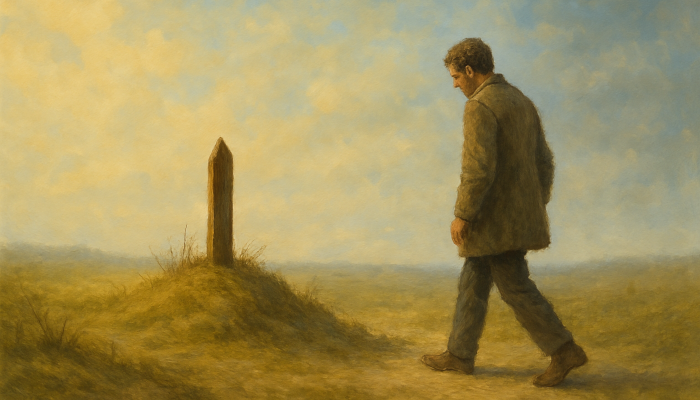
The past remains closed, buried like in a quiet grave of events, relationships, actions and feelings that have passed. On the surface remains only a marker, something like a small gravestone, a pale memory showing that something once lived there.
And yet not everything can be fully buried. Sometimes even in Oblivion a thin line remains.
These are the promises once made, but now connected not with a person or a face, but with your own ideas of honor and dignity, and to which you hold not because of others, but because of yourself, because you are not like them and the light in your morality does not depend on them. These lines are not bridges to the past, but bridges to your own spirit.
Human nature is made in such a way that memories fade. The biochemistry of the brain dissolves what was once lived, and everything old becomes covered by the layers of life that has passed. When the present is so different and everything from the past has lost meaning, the question appears whether forgiveness has any meaning at all. Oblivion has already done its work.
Time does not heal, it only weakens the neurons that hold old memories. The past has stopped existing as emotion and remains only as a bare fact.
And here the unforgivable returns again, the thing that time does not dissolve, that stays like a quiet sign which cannot disappear. And even if you forget, every time you pass through that place in your mind, you remember.
Forgetting is not revenge or punishment. It is the natural end of something that can no longer exist, and what has been sent into Oblivion stays there.
And maybe there is no harder fate for someone than to be forgotten, lost somewhere between memory and Oblivion.
© 2025 Nikola Vasilev